

The appointment cancelled two hours before I was supposed to be there. Something had come up on the other end, which was fine, because something had come up on my end too, namely the persistent and low-grade dread that had been attached to that particular obligation since I put it on the calendar. When the message came through, I sat with it for a moment the way you sit with unexpected good news, making sure it was real. Then I closed the calendar and did not open it again.
I got in the car and drove south.
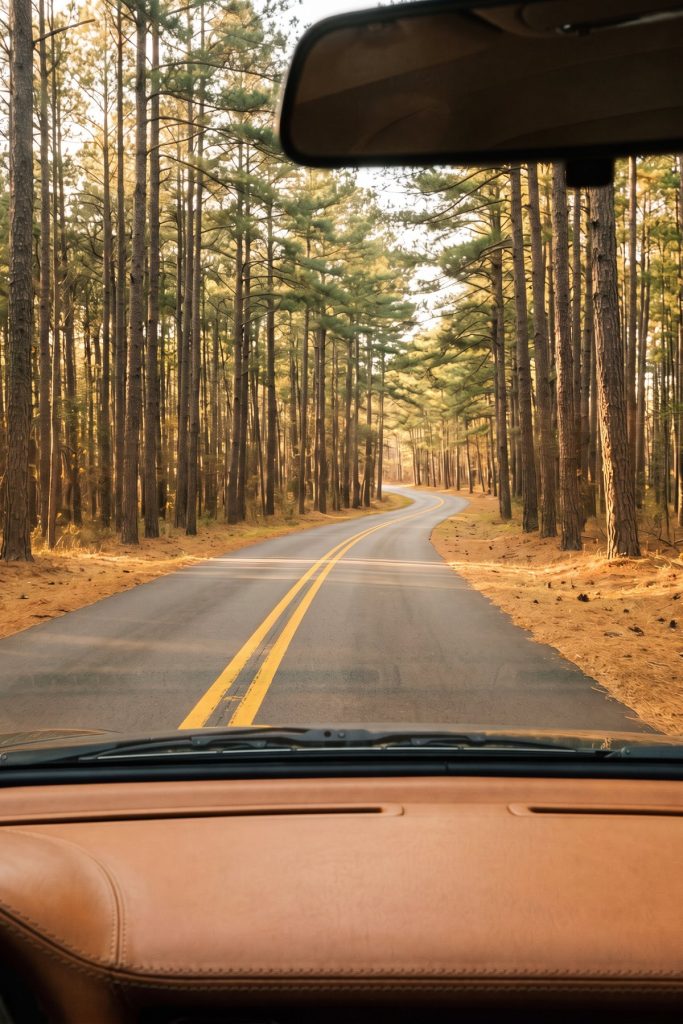
The road I had in mind is a two-lane parkway that moves through pine forest for long enough that you stop counting miles and start measuring the drive in something else entirely. No commercial traffic. No billboards. No trucks in the mirror announcing that the rest of the world is still conducting its business at full volume. The speed limit is fifty, which the road enforces through its own geometry: gentle curves, long straightaways through dense tree cover, the kind of pace that feels exactly right once you have stopped resisting it.
The car earned its place a long time ago. It starts reliably and asks very little in return, which sounds like a modest virtue until you have owned something that did neither. That kind of dependability is not ordinary. It is the product of a relationship built on reasonable expectations met consistently over time, and it turns out that is not a small thing. There is a road noise at highway speed, not a hum and not a grind but something steady in between, a low and even presence that functions as its own kind of silence. Through the vents, when the tree line pulls close on both sides, comes the faint smell of pine straw warming in the afternoon sun. It arrives and disappears and arrives again. The music was on low: Gordon Lightfoot, Boz Scaggs, Lyle Lovett, a mid-tempo playlist assembled without a theme except that everything on it belongs to a certain unhurried register. It was not the soundtrack to the drive. It was just there, the way good background should be.
I was not thinking about anything specific. That is the point, and it took longer than I would like to admit to understand that not thinking about anything specific is not the same as wasting time. For a long stretch of life, a free afternoon felt like an obligation: an opportunity that needed to be optimized, a gap that should be filled with something productive or at least accountable. The restlessness of that era was so constant that I mistook it for energy. It was not energy. It was noise.
What I know now is that the mind has a neutral gear, and most people never find it because they are always either accelerating or braking. The drive puts me in neutral. The pine trees move past at fifty miles per hour. The road makes its steady sound. Lightfoot finishes a song and Scaggs starts one and I do not reach for the dial.
At some point on a drive like this, something loosens. Whatever I carried into the car is still there on the back seat, but I am not holding it anymore, and the distance between me and it has widened to the point where it looks smaller than it did an hour ago. It does not disappear. That is not what this is. The drive does not solve anything or resolve anything or transform anything into something more manageable. It just creates enough space between you and the weight of the thing that you can see it clearly for the first time in a while, see its actual size rather than the size it becomes when you are carrying it. That is worth something. Most days it is worth quite a lot.
I turned around eventually, the way you do when the afternoon starts to close itself off and the obligations of the evening begin their low approach. The drive back is the same road in reverse, but it is never quite the same drive, because the person behind the wheel is not quite the same person who left. The return carries a different quality than the going out. Familiar miles now, the road already known, the mind still quiet but no longer emptying itself.
Four hours. A tank of gas and most of a playlist. I came back to the same afternoon I left, but something about the proportions of it had shifted, and the rest of the day fit inside those proportions without crowding anything.
Some afternoons you spend. Some you use. Every once in a while, one arrives that you simply inhabit, and you are better for it in ways that are difficult to explain to anyone who has not been on a road like that, at that speed, with the trees going past and the pine straw coming through the vents and the music just low enough to remind you it is there.